


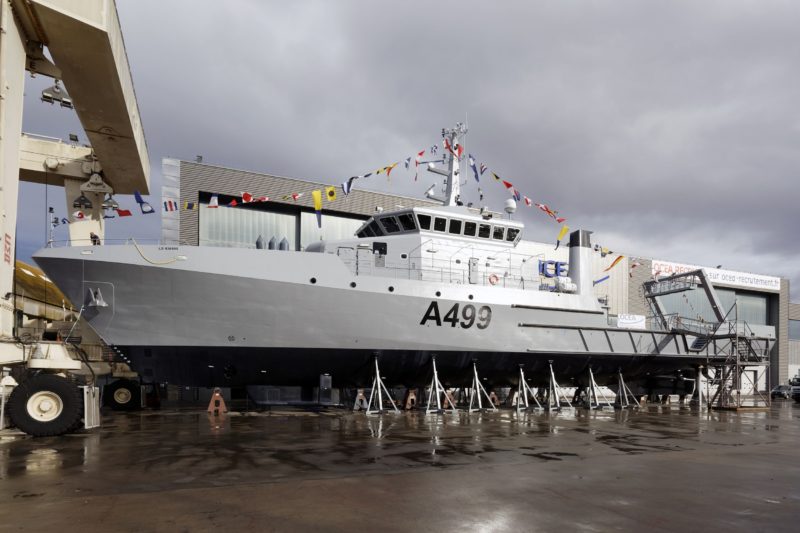
The Nigerian Navy has launched its first ever hydropgrapic survey vessel to enhance effective protection of the nation’s territorial waters. Following an international call for tenders for the acquisition of a research vessel designed specifically for hydrographic purposes, the Nigerian Navy selected OCEA in 2018 to carry out this contract.
The launching ceremony of the new OCEA OSV 190 SC-WB Hydrographic Research Vessel which is now called “LANA” took place on the OCEA site in Les Sables d’Olonne. Madam the Nigerian Ambassador to France, a delegation from the Nigerian Navy Headquarters from Abuja and representatives the French administration were present at the ceremony.
The award of this order to OCEA shipyard once again demonstrates the competitiveness of OCEA’s offer in the face of intense international competition (India, Spain, South Korea, South Africa, etc.). This new achievement also strengthens the presence of the OCEA Group in Nigeria, whose Navy already operates numerous patrol vessels from 24 to 35 meters built by OCEA. By the end of 2020, the Vendée shipyard will deliver two 35-meter FPB 110 MKII type patrol boats and four interceptors to the Nigerian Navy. Notably, this contract extends the Nigerian Navy’s fleet with a hydrographic research vessel tailored for scientific exploration.
Vessel’s missions
The OCEA OSV 190 SC-WB is a hydrographic and oceanographic research vessel from OCEA’s line of auxiliary vessels. As a Hydrographic Research Vessel, its specialized equipment makes it ideal for this work.
The “LANA” will allow the Nigerian Navy to have a better knowledge of its maritime territory and its Exclusive Economic Zone:
- Coastal and deep sea scientific research and studies (hydrography, oceanography) undertaken by the Hydrographic Research Vessel
- Fishing control
- Surveillance of the Exclusive Economic Zone
- Assistance and supplies to other boats
- Helicopter winching operation
- Towing of ships.
To carry out its missions, the ship will be equipped with high-performance technical and scientific means, in particular: this modern Hydrographic Research Vessel will utilize advanced systems.
- A deep water multibeam echosounder, which is standard on hydrographic research vessels
- A single beam depth-water sounder
- Side scan sonar
- A current meter
- Means of sampling, storage and analysis of water, fish and sediment aboard the Research Vessel
- Laboratory hardware and software
- An 8 m hydrographic boat equipped for data surveys along the coasts in small and very shallow waters.
The vessel designed by OCEA offers excellent operational capabilities thanks to optimized sea keeping, controlled integration of scientific systems and reduced impact on the observed environment: noise, radiation, as has been confirmed by SHOM and Kongsberg on the OSV 190 SC-WB “KRI RIGEL 933” and “KRI SPICA 934” operated by the Indonesian Navy. This is a common feature for Hydrographic Research Vessel designs in modern fleets.
Characteristics of the ship
- Length overall
60.10 m - Capacity
50 persons are onboard the Research Vessel - Speed
14 knots - Endurance
20 days, which is suitable for research vessel hydrographic missions - Autonomy
4400 nm @ 12 kts
Also Read:
Why is Hydrography Survey Important
Offshore Oil Exploration – Key Hydrographic Survey Insights
Nigerian Navy joins global mission to map the ocean floor
Nigeria introduces use of autonomous technology in hydrography
The Polish Navy acquires iXblue DriX USV to advance its hydrographic operations


