


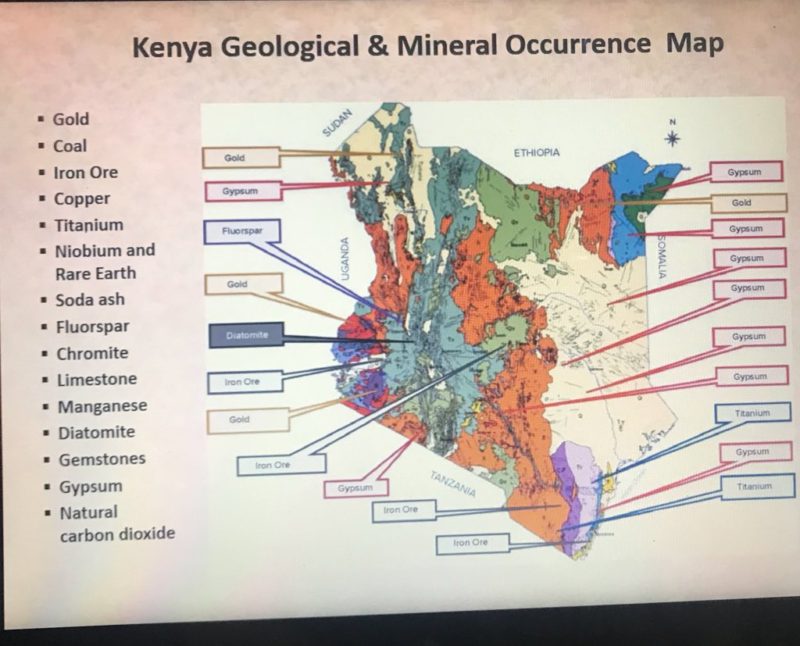
A survey to map Kenya’s mineral deposits is ongoing. Project leaders expect to conclude phase one of the project in about a month. Speaking at a virtual session looking at the country’s mining industry, Principal Secretary Ministry of Petroleum and Mining Andrew Kamau said the survey seeks to determine the number of underground minerals.
Developing the Mining Sector
He added that the Kenyan mining sector is at a nascent stage. The ministry is working on a law that will help define the sector. In addition, it will clarify the relationship between different players. This includes the government, artisanal miners, mining companies and investors.
“It’s a journey that takes longer but we want to work with investors to find a solution that works for everyone,’’ Kamau said.
Challenges and Sustainability
He added that being a mining house comes with its own challenges. As government, we have to think about a number of things. For example, we must consider sustainability in order to future-proof the sector. In this way, we can get the best of it.
”An aerial mapping to determine the country’s mineral wealth was 50% complete. He said, “We expect to complete the exercise by June this year.”
He added that the aerial survey has mapped only 4% of the country, yet its data plays a crucial role in encouraging investments into the sector.
Economic Potential
The Mineral Rights Board (MRB) chairman Stephen Kuria said that the country’s mineral sector has the potential to lift the economy significantly. This will only happen if the sector is well harnessed.
Kuria said that the ongoing Covid-19, which has disrupted nearly all sectors of the economy, hasn’t impacted the sector negatively. Prices of minerals like gold and copper have hit an eight-year high.
Kuria said that mining, which has the potential to contribute up to 11% of Kenya’s GDP, currently contributes only 1%. The sector is predominantly run by two corporates—Magadi Soda and Base Titanium. Moreover, the sector contributes Sh67billion to the country’s GDP.
In October 2016, British and Canadian consultancy firms International GeoScience Services and Paterson, Grant and Watson won a consultancy contract to oversee the 30 months-long survey.
The firms were to provide consultancy services for the development of specifications. They were also expected to prepare the terms of reference and supervise the survey.
Even so, the National Treasury recalled funds allocated for the survey in the supplementary budget as part of plans to cut expenditure by $1.7 billion (Sh170 billion).
Geophysical Survey Controversy with China
In 2013, Kenya had given China’s Geological Exploration Technology Institute (GETI) exclusive rights to do the geophysical survey with funding from Beijing. This move attracted opposition from the Kenya Chamber of Mines. The group said the deal amounted to ceding control of the country’s resources.
The mistrust of China’s prominent role in the survey has instigated a bitter falling out, prompting the Exim Bank of China to withdraw $65 million in funding, a move that eventually saw Kenya withdraw a contract given to GETI.
Legal and Regulatory Developments
Successive governments have had little success in trying to develop Kenya’s mining potential. Poor infrastructure and an outdated legal framework discouraged foreign exploration companies.
In 2016, the government enacted a new law. This law grants the government a 10 percent share, known as free carry interest, in projects that meet yet-to-be-determined minimum investment thresholds.
It also sets the average rate of royalties for the government for various minerals at six percent, with miners paying a lower rate when they process the minerals locally.
Mineral Deposits in Kenya
Kenya has proven deposits of titanium, gold and coal. Experts believe the country holds significant deposits of copper, niobium, manganese, and rare earth minerals.
President Uhuru Kenyatta created the Mining Ministry in 2013 to try and diversify the east African economy that relies mainly on tourism and agriculture.
Read More:
GIS Technology Enhances Innovations in Land Surveying
South African Firm to Conduct Regional Mineral Survey in Uganda
Geological Survey


