


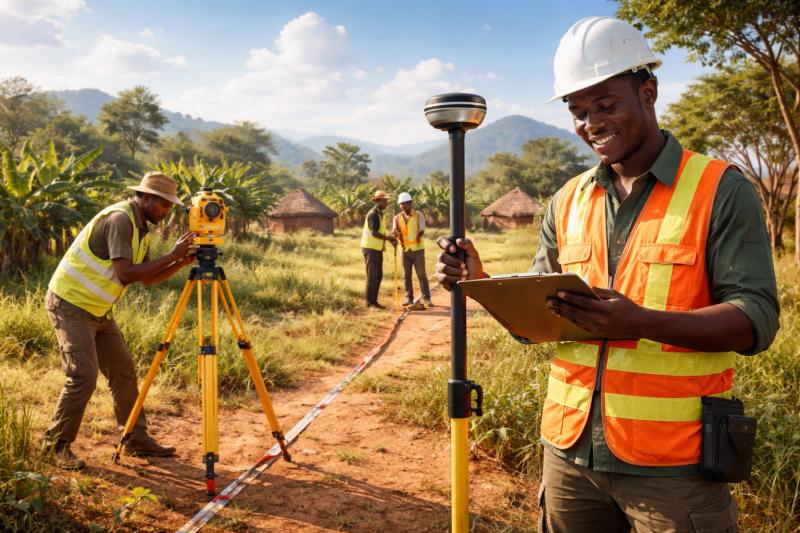
Land surveying plays a quiet but essential role in shaping the world around us. From the roads we drive and walk on to the buildings we live and work in, nearly every piece of infrastructure begins with accurate land measurement. Yet, many people still ask a simple question: what exactly is land surveying, and why does it matter?
At its core, land surveying is the science and art of measuring land to determine boundaries, distances, angles, and elevations. Surveyors collect precise data about the Earth’s surface and translate it into maps, plans, and legal documents. These outputs guide engineers, architects, planners, and governments in making informed decisions about land use and development.
The Foundation of Land Ownership and Development
Land surveying provides the legal backbone for property ownership. Before any land can be sold, developed, or subdivided, surveyors must define its exact boundaries. This ensures that property lines are clear and disputes are avoided.
In many African countries, where land ownership systems are evolving and urbanization is accelerating, accurate surveying is critical. Without reliable land data, conflicts over land can arise, delaying projects and affecting livelihoods. Surveyors help prevent these issues by establishing clear, legally recognized boundaries.
Beyond ownership, surveying supports planning and development. Whether it is a new highway, a housing estate, or a mining operation, surveyors provide the measurements that make construction possible. They assess terrain, identify obstacles, and ensure that projects align with design specifications.
How Land Surveying Works
Modern land surveying combines traditional techniques with advanced technology. Surveyors begin by collecting data in the field using specialized tools. These include total stations, GPS receivers, and drones. Each tool serves a specific purpose, from measuring angles and distances to capturing aerial imagery.
Once the data is collected, surveyors process it using software to create detailed maps and models. These outputs may include topographic maps, boundary plans, and 3D representations of the land.
The integration of digital tools has significantly improved accuracy and efficiency. Tasks that once took weeks can now be completed in days, allowing projects to move forward faster and with greater confidence.
For a deeper look at how modern tools are transforming surveying workflows, this industry resource offers valuable insights
Types of Land Surveying
Land surveying is a broad field with several specialized areas, each serving a unique purpose.
Boundary surveying focuses on determining property lines. Surveyors use legal records and physical evidence to establish the limits of a parcel of land.
Topographic surveying maps the natural and human-made features of an area, including elevation, vegetation, and structures. This information is essential for designing infrastructure.
Construction surveying ensures that buildings and infrastructure are constructed in the correct location and according to design specifications.
Geodetic surveying measures large areas of the Earth’s surface, taking into account its curvature. This type of surveying is crucial for national mapping and large-scale projects.
Each of the mentioned type plays a vital role in supporting development, ensuring accuracy, and maintaining order in land use.
The Role of Technology in Modern Surveying
Technology has transformed land surveying into a highly precise and efficient discipline. In particular, Global Navigation Satellite Systems (GNSS), commonly referred to as GPS, allow surveyors to determine positions with remarkable accuracy. Additionally, drones provide aerial views that help map large or difficult-to-access areas. Furthermore, laser scanning, or LiDAR, creates detailed 3D models of terrain and structures.
As a result, these innovations have made surveying faster, safer, and more reliable. Moreover, they also enable surveyors to work in challenging environments, such as dense forests, remote regions, or active construction sites.
Meanwhile, in Africa, the adoption of these technologies is growing steadily. Consequently, governments and private companies are investing in modern surveying tools to support infrastructure development, urban planning, and resource management. Ultimately, the quality and availability of geospatial data are improving across the continent.
Why Land Surveying Matters
Land surveying is more than just measurement, it is a critical tool for economic development and social stability. First, it supports infrastructure development. Accurate surveys ensure that roads, bridges, and buildings are constructed in the right place and to the correct specifications. This reduces errors, saves costs, and improves safety.
Second, it enables efficient land use. Planners rely on survey data to allocate land for housing, agriculture, industry, and conservation. This helps balance development with environmental protection.
Third, it reduces conflicts. Clear boundaries prevent disputes between landowners, communities, and governments. This is especially important in regions where land is a valuable and sometimes contested resource.
Finally, surveying supports investment. Reliable land data gives investors’ confidence to fund projects, knowing that boundaries and ownership are well defined.
The Future of Land Surveying
Digital transformation closely shapes the future of land surveying. Technologies such as artificial intelligence, cloud computing, and real-time data processing actively enhance the way surveyors work.
Digital twins, virtual models of physical environments, are becoming increasingly important in urban planning and infrastructure management. These models rely on accurate survey data to function effectively.
As Africa continues to develop, the demand for skilled surveyors and reliable data will only increase. Surveying will remain a cornerstone of progress, enabling smarter cities, better infrastructure, and more secure land ownership systems.
The Foundation of Every Great Development
Land surveying may not always be visible, but its impact is everywhere. It defines boundaries, guides construction, and supports development across every sector. By combining science, technology, and expertise, surveyors provide the foundation for a more organized and prosperous future.
Understanding what land surveying is, and why it matters, reveals just how essential this profession is to building Africa and the world at large.
Read More:
How to Conduct Property Boundary Surveys in Kenya
Cadastral Survey – What are Land Ownership Boundaries?
How Important Is Geotechnical Surveys in Foundation Design?


