


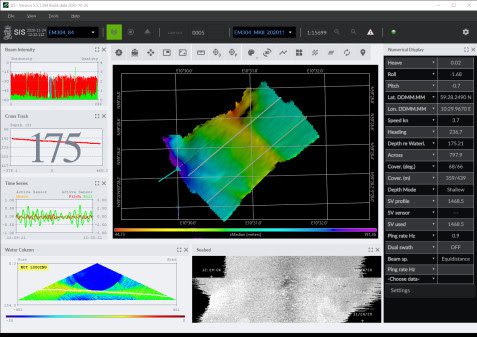
A multibeam echosounder is a type of sonar used to map the seabed. It emits waves in the form of a fan from a transceiver. This type of echosounder can produce detailed maps of the seabed. For example, it can determine the depth of the seafloor. To determine how deep the seabed is, multibeam echosounders use acoustic waves.
Depth Measurement and Signal Processing
A multibeam echosounder’s capability to detect depth is a key consideration. Accurately measuring motion is important for these instruments. The system measures the signal relative to a Cartesian coordinate system, the same framework used in navigation. It displays the data in terms of heave, pitch, roll, yaw, and heading. To compensate for these effects, multibeam echosounders employ a time-varying gain circuit to enhance the signal. The beams can be steered as needed, and a CUBE algorithm can be applied to the data to estimate depth.
Motion Compensation and Coordinate Systems
For multibeam echosounders to be effective, their motion measurement should be accurate. The system measures data relative to a Cartesian coordinate system and records signals as heave, pitch, roll, yaw, and heading. To compensate for signal losses, it uses a time-varying gain circuit. It also applies beamforming techniques, which improve accuracy compared to traditional methods.
A multibeam echosounder operates in both near-field and far-field regions. In the near-field, the spatial resolution equals the length of the array, which limits performance in shallow waters. In contrast, it improves far-field resolution by dynamically focusing beams. These systems are also much smaller than conventional alternatives, making them suitable for autonomous and remotely operated vehicles. In addition, recent innovations such as the CUBE algorithm enhance data processing and depth estimation.
Signal Transmission and Resolution
A multibeam echosounder is a device that sends short acoustic signals into the water. The amplitude and length of each ping is measured relative to a cartesian coordinate system. A short pulse length increases the vertical resolution. High-performance multibeam echosounders use optimized electronics that generate little to no noise. In contrast, a high-frequency multibeam echosounder is capable of measuring depth to several hundred feet.
A multibeam echosounder requires accurate motion measurement. It is able to measure the amount of motion in the ocean and calculate depth, including heave, roll, and yaw. The system is able to compensate for these motions by using a time-varied gain circuit. In addition to this, the CUBE algorithm uses an adaptive heaving-beam to optimize depth and angle of incidence.
Seafloor Mapping and Spatial Imaging
The multibeam echosounder is a device that consists of several beams. The system connects each beam to the others, and each beam receives a pulse. Each ping generates a contour, and the system places these contours side by side to form a three-dimensional image of the seafloor. This process, known as spatial imaging, helps map the seafloor.
Read More:


