


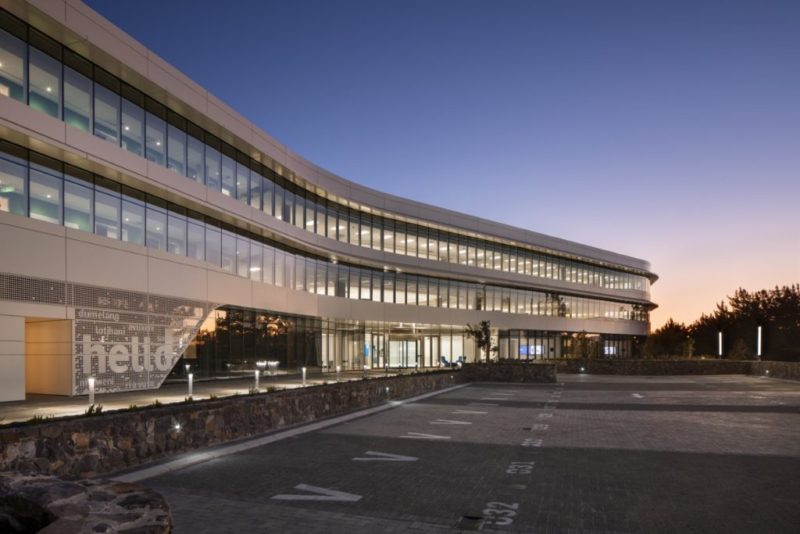
IKhaya means ‘home’ in Xhosa and Capitec Bank have built its new ‘home’ headquarters in Stellenbosch, Western Cape, South Africa. The bank stands as one of the largest and most progressive banks in Africa.
Multidisciplinary studio dhk Architects designed the three-storey curvilinear building. It reflects the company’s progressive outlook and agile working concept. Striking and otherworldly, their holistic approach optimises corporate expenditure, internal flow, and sustainability. As a result, this shows that commercial offices can be innovative, cost-effective, and operationally efficient.
Capitec’s success and growth over time meant that the company came to occupy numerous offices. These offices were geographically dispersed, resulting in departments becoming increasingly isolated from one another with the need to move between buildings to meet face-to-face. Consequently, Capitec opted to consolidate its staff and facilities into one operationally efficient headquarters. Located in the scenic Cape Winelands in South Africa, a key driver of the design concept involved capturing panoramic vistas and drawing the landscape within.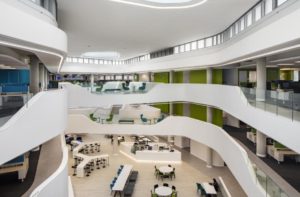
The building form optimises the shape and size of the site while referencing the brand’s distinctive curved logo. The three-storey superstructure wraps around itself. This design creates a unique ‘doughnut’ shape and forms a central triple-volume atrium – an internal ‘social spine’ at the heart of the building. Contributing to the contemporary appearance, white aluminium panels clad the building’s sinuous form. This shape is further accentuated with continuous ribbons of fenestration.
Interior design
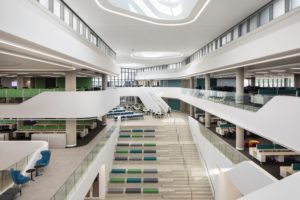
Inside, the design reflects the company’s progressive outlook, letting guests and staff experience the brand throughout the building. Visitors arriving at reception encounter a generous triple-volume space that highlights the interior’s sophistication and simplicity. Wide open-plan floorplates loop around the atrium’s periphery, while a series of dramatic bridges and staircases connect them. This was an intentional design element which inter-connects the various departments, creating opportunities for chance collaborative encounters and personal interactions.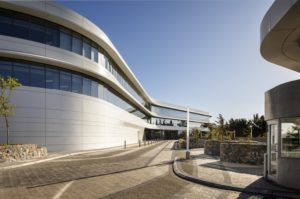
The designers based the interior on simplicity. They applied brand colours selectively in the reception and external meeting rooms to reflect the company’s values. Each core, or “hub,” received a distinct colour coordinated with surrounding furniture. This strategy helps staff navigate the building easily.
Signage enhances the design, appearing with light in the morning and fading in the evening to reveal a polished white finish. Large-format acoustic panel artworks in meeting rooms and vibrant upholstered furniture add warmth and contrast to the clean, modern interior.
Lighting design
The design reinforces Capitec’s brand identity by embossing the company logo into the ceiling above reception. Clerestory windows and large roof lights flood the space with natural light. This feature strengthens the connection to the outside environment. Throughout the office, designers incorporate timber elements to introduce warmth. They optimize natural light through clerestory glazing, roof lights, and internal courtyard windows. In addition, they zone artificial lighting and activate it with sensors for efficiency.
Lighting System Overview
Province Lighting installed a 1,4 km versatile linear system to deliver the ideal combination of illumination and architectural enhancement. The company developed a custom lighting solution that follows dhk Architect’s curved building design and effectively illuminates the space. Additionally, Sirius down lights enhance general circulation areas within the building.
Design Challenges & Innovation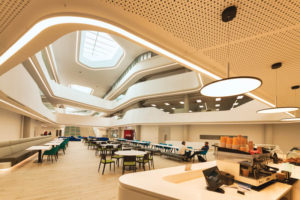
“The first requirement in terms of lighting was to meet the SANS requirements, and secondly to be efficient. The curvilinear geometry of the interiors did present a challenge, however. We wanted to ‘scribe’ the shape of the atrium form in accent lighting and traditional details and LEDs proved unsatisfactory,” explains Peter Stokes, partner at dhk and lead architect on the iKhaya project. “A new lighting product became available during the course of the building’s design that allowed us to simplify the bulkhead/cove detail and simplify construction,” he adds.
Sustainability & Light Control Strategy
Stokes notes that the design intentionally restrains the lighting. The client discouraged external lighting that highlights the building. Because of the site’s sensitivity and prominence, the team prioritized minimizing light pollution for neighboring developments. “Therefore, we allowed only minimal artificial lighting to accent the building and optimized natural light to illuminate the atrium space. Elsewhere, lighting solutions were specific to particular activity areas, including open plan resident desk areas, meeting rooms, collaboration spaces, pause areas, kitchenettes, and back-of-house areas.
Steel solution – Complexity in design
In January 2019 Macsteel partnered with AECOM & LRJ steel for the design and development of Capitec Bank’s new head office and adjoining parking structure. Succeeding the consultation with the architect, the understanding was to design and build a contemporary, open office. This office allowed a fluid and collaborative work environment. From the start of the project, the team used Building Information Models (BIM), which represented the actual construction. Consequently, this approach allowed all partners involved to fully understand the configuration of the planned structure. As a result, they ensured a collaborative vision of how the various components interacted.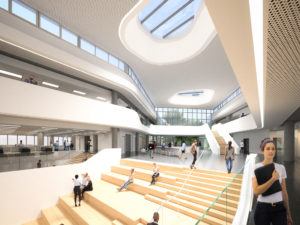
The design solution was predominantly a concrete framed structure. However, structural and composite steel and concrete construction were used in a complimentary way. Additionally, bridge links and the floor over the mail entrance required light, long span structures with limited headroom implications. The parking structure required the use of a solution that would be removable in the long term conversion of the building for a different use.
Optimising internal flow
The new headquarters by dhk fosters a company culture of creativity, innovation and collaboration with a large emphasis placed on optimising internal flow and departmental interaction. The first and second floors, containing the office’s open-plan work areas, are largely void of hierarchal structure and closed-off cubicles. Embracing the concept of agile working, a raised access floor throughout the building facilitates maintenance and future upgrades to services. On each level, a total of four ‘cores’, containing centralized amenities such as kitchenettes, meeting rooms, breakout areas, lockers, bathrooms and fire escapes, serve to augment the floorplates into departmental zones.
Throughout the building’s ‘social spine’ there are a variety of breakaway areas; from a large ground-floor lounge at reception for guests to await meetings and co-workers to engage, to pause areas on bridges, and an internal landscaped courtyard for staff to rest. These spaces fuel creativity and innovation by allowing employees to slip away from their resident desks to enjoy a moment of solitude, conduct a private meeting or brainstorm ideas in small groups.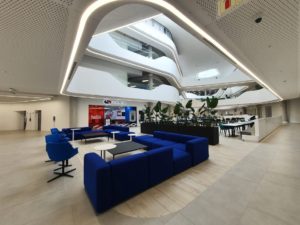
Not only do these breakout areas increase job satisfaction, but they boost staff productivity and efficiency. Furthermore, there is a full-service kitchen and canteen area with ample seating, a small satellite café, and a grand multifunctional stadium staircase/seating area for company presentations and talks. Other useful facilities include a recording studio, Capitec Bank branch and an ATM lab facility.
Comfort solution
Capitec has championed environmental sustainability and employee well-being throughout the building particularly where it made sense and value could be demonstrated. Even the air conditioning system is based on these values. To enhance the energy efficiency of the building while maintaining internal comfort all year round.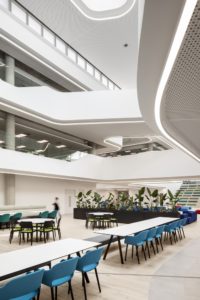
Since a large part of the building features large open-plan spaces for the training rooms and offices, these areas were fed with air-handling units located at the roof plant. A requirement was that the meeting rooms should be noise sensitive.
In general, the building has been zoned by similar usage spaces, Internal seating zones as well as external perimeter zones. The benefit of the zoning feature is that the building can be either heated or cooled simultaneously.
Bonding Solution
Sika completed the glazing of the glass on the Capitec building as one of the final finishing stages. The glass serves as a striking feature that enhances the overall appearance of the building. Therefore, the team used a range of Sika products to ensure its stability and security. They used Sikasil® IG-25 Structural Secondary Seal to manufacture the double-glazed insulated glass. They also applied Sikasil® SG-500, a two-part structural silicone, to bond the insulated glass units to the façade frame. Also used Sikahyflex®-305 AP Weather Sealant and the surface preparation primer, Activator-205 Cleaner for Aluminium, to weather-seal the bonded insulated glass units on the façade. Altogether, the project used a total of 3,850m² of glass. The value of the glazing products reached approximately R1.58 million.
Major challenges of this project were to meet daily insulation and manufacturing targets, whilst managing the transportation and handling of panels. Despite the difficulties, one of Sika’s reliable technical consultants, Chris Sharpe, ensured that damaged panels were replaced and new installations effected smoothly. No doubt the technical training and support afforded the contractors by Sika, contributed greatly to the success of the project.
“The Capitec Headquarters is one of the most architecturally beautiful corporate buildings in the country. The ability to accommodate all the business branches in one building enables an effective and efficient working unit. Looking at the result, most would agree it was definitely a necessary and worthwhile project. Bank on it!,” says Sika.
Sustainable measures
Environmental performance modelling directly influenced the articulation of the façade. The design applied a climate- and site-responsive approach to the fenestration layout. Excess solar heat was reduced by adjusting the building’s ribbon of fenestration to match its varying orientation. This guided decisions on glazing, glare control, solar shading, and internal layouts. For instance, a circulation zone along the perimeter separates resident desks from radiant heat sources.
The concrete superstructure exposes thermal mass, and the basement uses natural ventilation. Additional measures include ice storage to reduce peak electricity demand, greywater recycling, water-saving fittings, building management systems for monitoring, double glazing, durable low-maintenance locally sourced materials, water-efficient heat rejection, zero-ODP refrigerants, low-VOC finishes, borehole and rainwater harvesting for irrigation, water-wise planting, and waste separation for recycling.
Employee Well-being & Active Design
The building promotes employee well-being by limiting access to only two passenger lifts for its workforce of approximately 2,000. The design includes generous feature stairs that encourage walking and reduce reliance on lifts. Fire escape stairs were upgraded with high-quality finishes to function as ‘communication’ stairs.
To support well-being and ensure universal access, Capitec consulted a disability expert and an acoustic specialist early in the design. Their recommendations guided the installation of sound-absorbing materials and acoustic separation between meeting rooms to meet the required decibel reduction.
Inclusive Infrastructure & Accessibility
Additionally, the design goes beyond regulatory requirements by addressing the spirit of universal and inclusive access. It considers car parking locations, emergency evacuation, ablutions, and vertical circulation. In this way, the design ensures accessibility for all.
Capitec refurbished a nearby public space for staff and the community to enjoy walking, running, and other recreational activities. Fittingly, the building also provides cyclist facilities and purpose-designed showers.
Future-Proof Design & Adaptability
The development includes an adaptable car park that can convert to office space if public transport use rises and car reliance falls. Peter Stokes, partner at dhk and lead architect on iKhaya, says, “Capitec embodies simplicity, innovation, and collaboration. We aimed to create a world-class office that is agile, boosts productivity, improves efficiency, and reduces operational costs.”
Also Read:


